



— TORONTO OFFICE MARKET OUTLOOK 2026
The window of opportunity that defined Toronto’s office market over the past few years is closing. For companies navigating office space in Toronto, the landscape is shifting quickly.
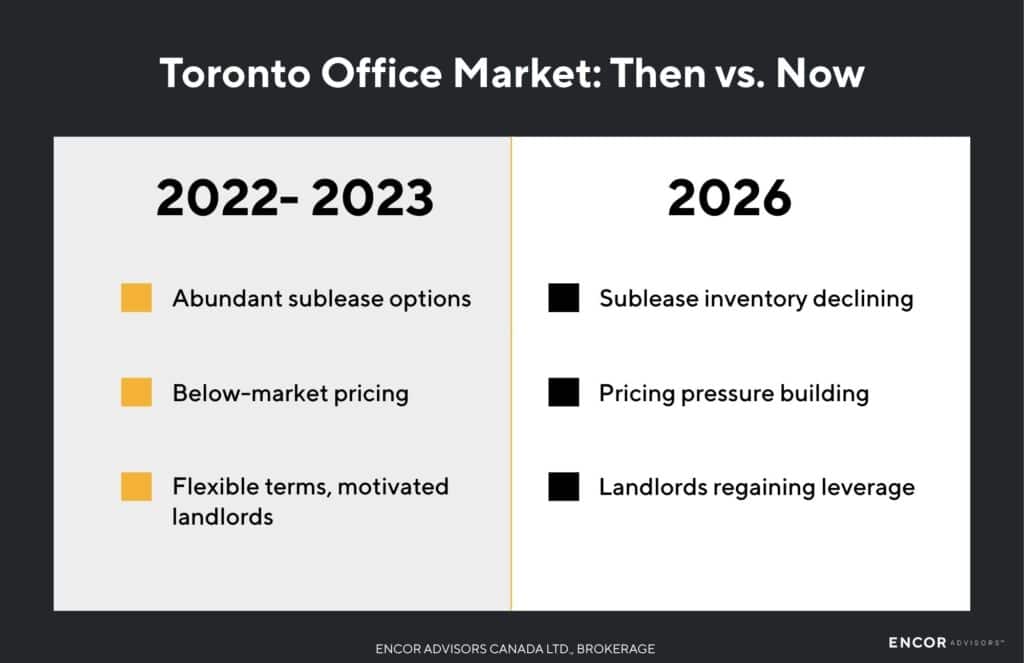
Abundant space, motivated landlords, and generous incentive packages are giving way to tighter conditions. Sublease inventory is declining from recent peaks, construction costs are making new supply more difficult to justify, and tenants are increasingly competing for a narrowing pool of premium space.
For companies with a lease event on the horizon, the market you’re stepping into looks very different from the one you may have navigated in 2022 or 2023. Understanding why matters, and so does working with the right corporate real estate advisor in Canada.
For a few years after 2020, Toronto’s office market was flooded with sublease availability. Companies that downsized during the pandemic had no shortage of options, and tenants knew it. Below-market pricing, furnished space, flexible terms. It was a buyer’s market.
That environment is changing.
Toronto’s sublease market is declining from recent peaks, and the dynamic is shifting.
What was once a market flooded with options is becoming more competitive, with fewer turnkey and discounted opportunities available. Many of the spaces that gave tenants flexibility over the past few years are no longer coming back to the market.
What was once abundant is becoming increasingly limited.
For downtown Toronto specifically, sublease availability has been trending downward as more space is absorbed.
One of the primary drivers is return-to-office. Major employers are bringing employees back more consistently, and companies are holding onto space they may have otherwise planned to sublease.
At the same time, fewer new sublease listings are coming to market.
The tenant-friendly sublease market that defined the past few years is fading quickly.
The curated, discounted sublease opportunities that gave tenants real leverage over the past few years are becoming increasingly difficult to find.
If shrinking sublease inventory were the only variable, you might expect developers to build their way out of the problem. But the economics of new office development in Toronto say otherwise.
According to Altus Group, office fit-out costs in Toronto can range approximately $200–300 per square foot depending on scope and level of finish. While actual costs vary widely by project, the broader trend is clear: construction costs have risen materially in recent years.
Toronto has also seen significant cost escalation, ranking among the fastest-growing globally in recent years. This sustained increase continues to put pressure on new development.
Long approval timelines, ongoing construction cost pressures, and broader economic factors continue to constrain new development.
Statistics Canada’s Q3 2025 Building Construction Price Index shows that non-residential construction costs increased approximately 4% year over year, reinforcing the upward pressure on development costs.
New Class A office supply remains limited in the near term. For tenants expecting a near-term reset in availability, that shift is unlikely to happen anytime soon.
The best opportunities today are not necessarily discounted, they’re simply the ones that still exist.
As sublease availability declines and new supply remains constrained, the market is increasingly favouring landlords, particularly those holding Class A and AAA product.
Pricing pressure is building in downtown Toronto office space as demand becomes increasingly concentrated in high-quality, well-located buildings.
With fewer sublease alternatives on the table, landlords in the top tier are facing less competition than they have in recent years. For tenants seeking premium space, the negotiating dynamic has meaningfully shifted.
This is where strong lease negotiation services in Toronto makes a difference, not just in headline rent, but in the terms, tenant improvement allowances, and flexibility provisions that shape how well a lease supports your business over time.
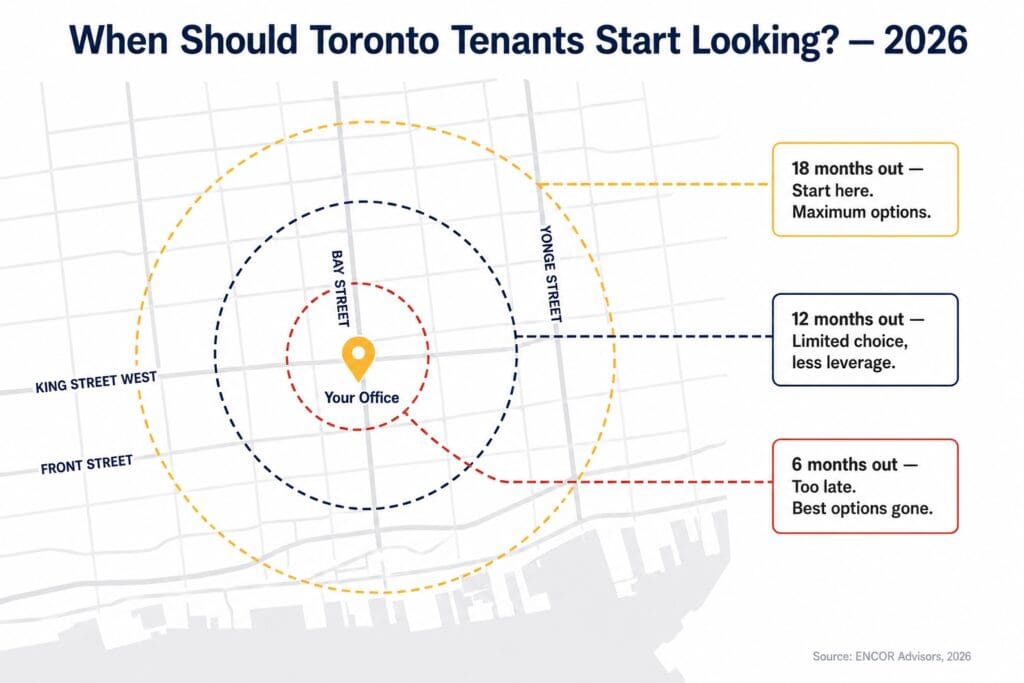
The most important thing tenants can do right now is give themselves time and information.
This is especially critical for companies evaluating tenant representation in Toronto or preparing for upcoming lease negotiations.
The standard playbook of going to market six to nine months before expiry does not hold up in a supply-constrained environment.
By the time you have identified a shortlist, completed due diligence, and worked through lease negotiations, the best options have moved. Eighteen months is the new twelve. If your lease expires in 2027, that conversation should be starting now.
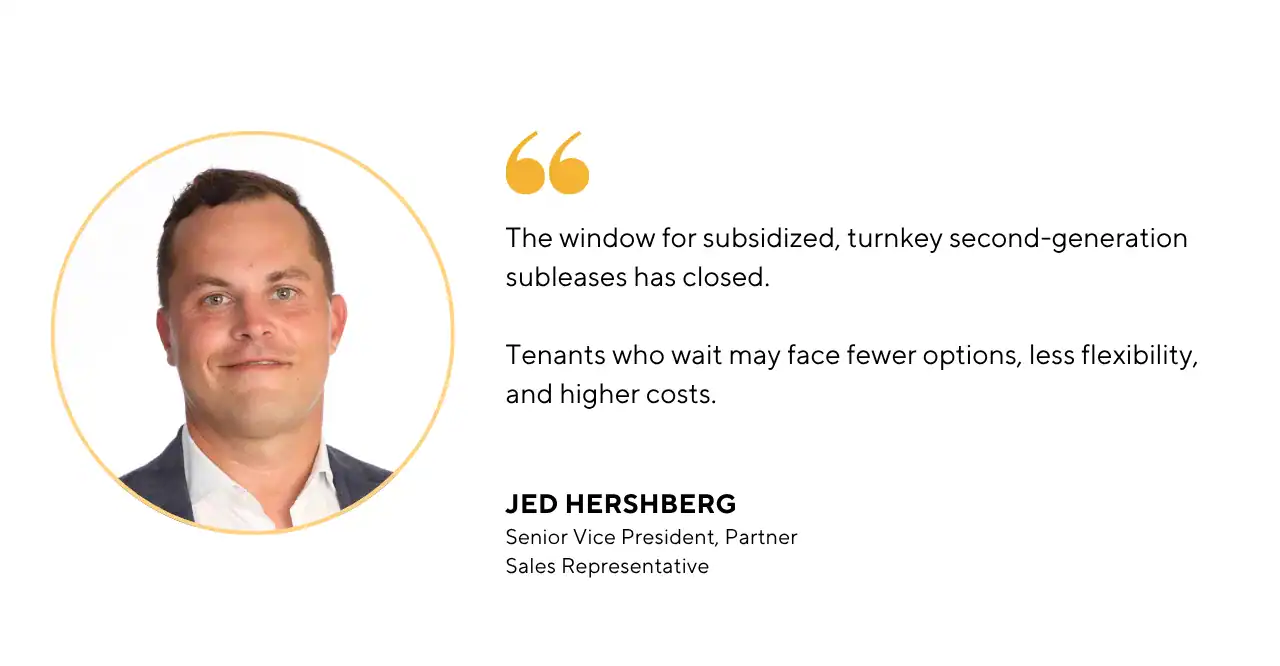
The most consequential decision in this market is who is at the table with you. Most major brokerages in Toronto represent both landlords and tenants, sometimes on the same deal. That conflict does not disappear because it is disclosed. A dedicated tenant representation specialist in Toronto brings something different: a mandate that runs entirely in one direction. In a market where landlords have reclaimed meaningful pricing power, that distinction is not a formality. It is where deals get made or given away.
ENCOR Advisors is a Toronto-based commercial real estate brokerage that represents tenants exclusively. We help companies secure better office outcomes through tenant representation, lease negotiation support, and lease administration services across Canada. Our approach is simple. Your interests come first.
If your lease is coming up, or if you want a clear view of your options in today’s market, speak with our team to better understand your options in today’s Toronto office market.
Your questions answered
Yes. Sublease availability is declining and new supply remains limited, reducing tenant choice and increasing competition for well-located, high-quality space.
Fewer companies are offloading space, and more are bringing employees back to the office. At the same time, new sublease listings are not replacing what’s being absorbed.
Pricing pressure is building, particularly in Class A and AAA buildings. As availability tightens, landlords are regaining leverage in negotiations.
Earlier than before. In a tighter market, starting 12–18 months ahead of lease expiry gives tenants more options and better negotiating position.
Opportunities still exist, but they are more limited.
The best spaces are being secured faster, so timing and strategy are becoming more critical.
By planning early, understanding market conditions, and working with a tenant-focused advisor. Strong negotiation and access to off-market opportunities can make a meaningful difference.





| Cookie | Duration | Description |
|---|---|---|
| cookielawinfo-checkbox-analytics | 11 months | This cookie is set by GDPR Cookie Consent plugin. The cookie is used to store the user consent for the cookies in the category "Analytics". |
| cookielawinfo-checkbox-functional | 11 months | The cookie is set by GDPR cookie consent to record the user consent for the cookies in the category "Functional". |
| cookielawinfo-checkbox-necessary | 11 months | This cookie is set by GDPR Cookie Consent plugin. The cookies is used to store the user consent for the cookies in the category "Necessary". |
| cookielawinfo-checkbox-others | 11 months | This cookie is set by GDPR Cookie Consent plugin. The cookie is used to store the user consent for the cookies in the category "Other. |
| cookielawinfo-checkbox-performance | 11 months | This cookie is set by GDPR Cookie Consent plugin. The cookie is used to store the user consent for the cookies in the category "Performance". |
| viewed_cookie_policy | 11 months | The cookie is set by the GDPR Cookie Consent plugin and is used to store whether or not user has consented to the use of cookies. It does not store any personal data. |