



Most Toronto companies treating ESG seriously have built out the reporting stack, committed to net-zero targets, and started showing up at events like Toronto Climate Week.
Then they sign a lease that undermines all of it.
The sustainable office lease conversation in Toronto is maturing fast. Landlords are publishing ESG reports. Buildings are chasing LEED and BOMA BEST certifications. Green lease negotiations are multiplying. Carbon language is appearing in more term sheets than it was two years ago. But the gap between what a building markets and what a lease actually delivers for a tenant is still wide enough to swallow a sustainability strategy whole.
This is not a problem with your intentions. It is a structural problem with how commercial leases are negotiated, and most tenants do not discover it until they are locked in.
Toronto Climate Week 2026 carries the theme “The Canadian Competitive Advantage” and that framing is pointed and correct.
Canada’s ability to attract climate-tech investment, retain ESG-focused talent, and position its business community in a decarbonizing global economy depends on more than policy.
It depends on whether the companies making sustainability commitments actually operate in spaces built to deliver them. For many, the answer right now is: not quite.
Six dimensions of your lease determine whether your space supports your sustainability goals or quietly works against them. Most tenants have addressed one or two. Almost none have addressed all six.
Toronto’s office market is carrying significant available space heading into 2026.
Downtown Toronto office availability remains elevated as companies continue to right-size footprints post-pandemic. That supply-side reality gives tenants negotiating leverage they have not had in over a decade.
For ESG-focused companies, that leverage has a specific application: green lease negotiations and pushing for provisions that landlords would have resisted in a tighter market.
Green leases, sometimes called aligned leases or sustainable leases, embed shared obligations around energy performance, metering access, disclosure, and fit-out standards into the lease document itself.
They move sustainability from a landlord marketing claim to a binding contractual commitment.
BOMA Canada‘s national work on the green lease framework, alongside the Canada Green Building Council‘s ongoing standards evolution, has given the market clearer language to work with.
The tools exist. The question is whether tenants are using them.
The office market moment and the ESG moment are arriving together. Toronto companies negotiating leases right now have the market conditions to demand sustainability alignment. Most are not asking for it.
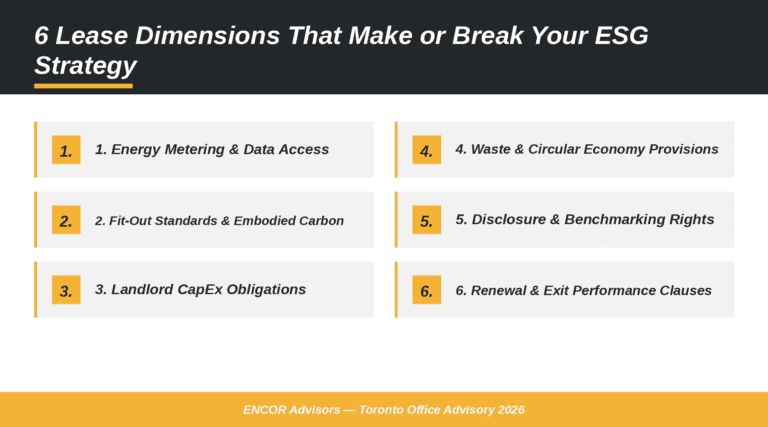
A building can carry LEED Gold certification and still give you no direct access to your energy consumption data.
The lease is what determines whether you have the right to sub-metered data at the tenant level, the right to receive it in a machine-readable format, and the right to share it with your Scope 1 and 2 reporting processes.
Without granular energy data, your sustainability reporting is estimated. Estimated reporting is increasingly insufficient for institutional investors, lenders aligned to the Task Force on Climate-related Financial Disclosures (TCFD), and corporate customers with supply-chain sustainability requirements.
The lease provision that grants or withholds your metering access is often a single clause. Most standard lease templates omit it entirely.
Your fit-out is where embodied carbon lives: the concrete, steel, millwork, and systems installed to make a raw shell into a working office.
A lease can specify fit-out material standards, require low-VOC and sustainably sourced materials, or mandate LEED for Commercial Interiors (LEED CI) compliance.
It can also say nothing at all, leaving your fit-out decisions entirely unconstrained.
For companies with science-based targets that include Scope 3 emissions, the fit-out is a material source of emissions that sits entirely within your decision-making control.
The lease is where you set the rules for it. If your lease doesn’t address fit-out standards, those decisions will default to cost and schedule rather than carbon.
Waste diversion rates are increasingly material to ESG reporting, particularly for companies aligned to Global Reporting Initiative (GRI) standards or pursuing B Corp certification. The lease determines whether you have access to building waste infrastructure, whether your landlord is obligated to maintain it to a defined standard, and what happens when diversion targets are missed.
Toronto’s municipal waste diversion programs set a floor. Your lease can set a ceiling; committing both parties to higher diversion standards and building the reporting mechanism into the tenancy structure. Without lease-level provisions, waste performance is a landlord operational choice, not a shared obligation.
Green building performance degrades without ongoing landlord investment in building systems: HVAC upgrades, window performance, LED lighting, building automation, and electrification of mechanical systems.
Most commercial leases give landlords wide discretion over capital expenditure timing and scope.
A well-structured green lease includes landlord performance obligations tied to building energy intensity targets, with transparency requirements around capital planning.
Without them, a landlord can allow building systems to age past the point where tenant efficiency measures can compensate.
Your energy performance becomes a function of landlord capex decisions you have no contractual visibility into.
Waste diversion rates are increasingly material to ESG reporting, particularly for companies aligned to Global Reporting Initiative (GRI) standards or pursuing B Corp certification.
The lease determines whether you have access to building waste infrastructure, whether your landlord is obligated to maintain it to a defined standard, and what happens when diversion targets are missed.
Toronto’s municipal waste diversion programs set a floor. Your lease can set a ceiling; committing both parties to higher diversion standards and building the reporting mechanism into the tenancy structure.
Without lease-level provisions, waste performance is a landlord operational choice, not a shared obligation.
ENERGY STAR Portfolio Manager benchmarking and the City of Toronto’s large building energy and water reporting requirements apply to buildings above certain thresholds.
But tenant-level benchmarking rights, i.e., your ability to see how your specific suite performs against comparable spaces, require explicit lease language.
As more institutional investors request property-level sustainability data from their portfolio companies, and as lenders align sustainability-linked financing to disclosed operational performance, the ability to produce credible, independently verifiable building performance data becomes a financing, governance, and reporting issue.
The lease either gives you that data access or it doesn’t.
The longest-horizon sustainability lever in any lease is what happens at renewal.
Green leases increasingly include provisions that ratchet performance obligations upward at renewal: higher energy intensity targets, updated fit-out standards aligned to evolving codes, landlord obligation to meet new emissions benchmarks before a renewal is executed.
These are negotiating points, not standard clauses. They require a tenant who knows to ask for them before the lease is signed.
Exit provisions also matter. If a landlord materially underperforms on disclosed sustainability obligations, a well-constructed lease gives the tenant a performance remedy.
Without that provision, your sustainability commitments are unilateral.
The companies leaving Toronto Climate Week with genuine competitive advantage are not the ones with the best sustainability reports.
They are the ones whose operational infrastructure is built to deliver on what those reports promise.
A well-run sustainable lease process starts with a sustainability brief developed before the space search begins.
That brief translates corporate ESG commitments, Scope emissions targets, and reporting obligations into specific lease requirements: the clauses that must be present, the landlord performance standards that are non-negotiable, and the disclosure rights without which reporting cannot be credible.
The brief then drives the space search. Building certifications are a starting point, not a conclusion. A LEED Gold building that will not accept a green lease addendum is a less valuable option than a LEED Silver building with a landlord who engages seriously on performance obligations.
Tenant representation that understands the green lease framework can evaluate that trade-off. Generic commercial brokerage typically cannot.
Not sure whether your current lease supports your sustainability commitments? Click here to find out.
Once spaces are shortlisted, the lease negotiation must be run in parallel with your sustainability and legal teams, not sequentially with them reviewing a near-final document.
The green lease provisions most valuable to tenants, including metering rights, landlord capex obligations, and performance remedies, are easiest to negotiate when the landlord still has deal risk. They become very difficult after heads of agreement are signed.
The Canada Green Building Council publishes a green lease guide that gives both tenants and landlords a starting framework.
ENCOR’s advisory work builds on that foundation, translating the standard framework into tenant-specific negotiating positions aligned to a client’s actual ESG commitments and reporting obligations.
ESG governance has matured quickly at the board level. Audit committees are reviewing TCFD disclosures. Compensation committees are tying executive pay to sustainability milestones.
But the question “does our lease enable our sustainability commitments?” is rarely on the board agenda.
Real estate is typically among the largest Scope 1 and Scope 2 emission sources for office-based companies.
It is also a multi-year contractual commitment that either builds or constrains sustainability performance for the length of the term.
A company that signs a ten-year lease in 2026 without green lease provisions has locked in a sustainability constraint through 2036.
That is a governance risk that belongs in the ESG disclosure framework.
ENCOR’s real estate consulting services empower clients to navigate this landscape effectively, so you can capitalize on emerging opportunities while addressing potential challenges.
Learn more about our ESG/Sustainability consulting services here.
Your questions answered
A certified building, whether LEED, BOMA BEST, or another standard, confirms that the building’s design and systems meet defined performance criteria at the time of certification.
A green lease is a contractual document that creates ongoing shared obligations between landlord and tenant around energy performance, data disclosure, fit-out standards, and waste management.
The two are distinct and both matter.
A certified building without a green lease gives you a good physical platform but no contractual assurance that it will perform for your specific tenancy. A green lease in a non-certified building at least gives you the data access and performance obligations to measure and improve. Ideally you pursue both.
The short answer is: it depends on who you are and when you ask.
Major institutional landlords in the downtown core are increasingly familiar with green lease language and have internal ESG teams engaged on tenant sustainability requests.
They are more receptive now than they were two years ago, in part because their own investor and lender disclosures require building-level performance data that green lease provisions help generate.
Landlords benefit from green leases too. That alignment is a negotiating asset. Ask early, ask specifically, and be prepared to explain what you need and why.
Vague requests for “sustainability language” are easy to dismiss. Specific asks grounded in your reporting obligations are harder to refuse.
Toronto Climate Week 2026’s theme of “The Canadian Competitive Advantage” is largely about positioning Canada as a destination for climate capital, talent, and innovation.
That positioning depends, in part, on whether the companies operating here can credibly demonstrate ESG performance to global investors and customers.
Lease terms are a significant part of that credibility. A company with a strong sustainability strategy that cannot produce granular building energy data, or that operates in a space built without embodied carbon standards, has a gap in its ESG evidence base. Closing that gap is partly a real estate decision.
Almost certainly yes.
LEED certification is awarded to the building at a point in time and is based primarily on design and systems performance, not on the contractual terms of individual tenancies.
Tenant-level sub-metering rights, fit-out material standards, landlord capex obligations for maintaining building systems, and performance disclosure rights are rarely automatic in a LEED building.
They need to be negotiated into your specific lease. LEED certification is a strong starting point for a sustainable office lease Toronto negotiation. It is not the finish line.
Scope 1 covers direct emissions from sources your organization controls: natural gas combustion in your space, for example.
Scope 2 covers indirect emissions from purchased electricity.
Scope 3 covers all other indirect emissions, including those embedded in the materials and goods your organization uses.
For office tenants, Scope 1 and Scope 2 emissions are most directly tied to building energy performance, which your lease can influence through metering rights, performance obligations, and building system standards.
Scope 3 emissions for office tenants are most directly tied to fit-out decisions, where lease provisions around material standards and LEED CI compliance are relevant.
The lease is not your only lever on any of these, but it is a more powerful lever than most companies use.
If you are currently in lease negotiations or approaching renewal, there are provisions you can negotiate now that will improve your Q3 and Q4 reporting.
Metering access rights and landlord disclosure obligations, once granted, can produce usable data within the current lease year. Fit-out standards apply forward, not retroactively.
Landlord capex obligations take effect based on agreed timelines. The most impactful provisions, the ones that will affect your sustainability performance across a full lease term, require being negotiated before a lease is signed. If you are mid-term with no renewal in sight, the near-term levers are operational, not contractual.
That said, most leases contain provisions tenants have not fully activated: disclosure rights that exist but have never been exercised, waste infrastructure access that has never been formally requested.
A lease review is worth doing before concluding there is nothing to work with.
The green lease framework applies across asset classes, with different emphases.
Industrial tenants are focused on energy intensity per square foot of warehouse or manufacturing space, truck dock electrification infrastructure, and solar access rights for rooftop installations, a provision that is increasingly significant for large-footprint tenants.
Data centre tenants are focused on Power Usage Effectiveness (PUE) commitments, water usage effectiveness for cooling, and renewable energy procurement rights.
The principles are the same: the lease is where sustainability commitments either become contractually binding or remain aspirational. The specific provisions differ by asset class and use.





| Cookie | Duration | Description |
|---|---|---|
| cookielawinfo-checkbox-analytics | 11 months | This cookie is set by GDPR Cookie Consent plugin. The cookie is used to store the user consent for the cookies in the category "Analytics". |
| cookielawinfo-checkbox-functional | 11 months | The cookie is set by GDPR cookie consent to record the user consent for the cookies in the category "Functional". |
| cookielawinfo-checkbox-necessary | 11 months | This cookie is set by GDPR Cookie Consent plugin. The cookies is used to store the user consent for the cookies in the category "Necessary". |
| cookielawinfo-checkbox-others | 11 months | This cookie is set by GDPR Cookie Consent plugin. The cookie is used to store the user consent for the cookies in the category "Other. |
| cookielawinfo-checkbox-performance | 11 months | This cookie is set by GDPR Cookie Consent plugin. The cookie is used to store the user consent for the cookies in the category "Performance". |
| viewed_cookie_policy | 11 months | The cookie is set by the GDPR Cookie Consent plugin and is used to store whether or not user has consented to the use of cookies. It does not store any personal data. |