


The cost of building a standard data centre has risen 47% since 2020.
In 2026, the gap between a conventional enterprise build and an AI-optimized facility is wider still. Before you commit to a build, a colocation agreement, or a cloud-heavy strategy. Understanding which cost structure applies to your organization is now one of the more consequential infrastructure decisions a Canadian executive will face this decade.
This article breaks down what construction actually costs in Canada today, where operational costs accumulate over time, and how the build-versus-outsource decision plays out when AI workloads are in scope.
The snapshot below summarizes common 2026 data centre cost ranges in Canada before the article breaks down the factors that can change the final number.
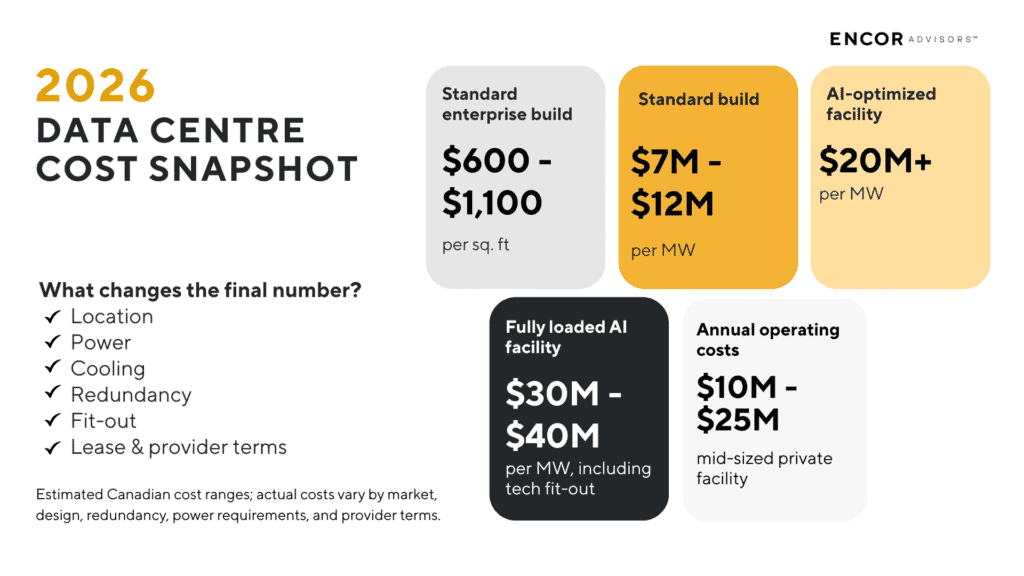 Sources: Turner & Townsend Data Centre Construction Cost Index 2025; Altus Group 2026 Canadian Cost Guide; Statistics Canada Building Construction Price Index.
Key cost benchmarks for 2026:
These costs are not only technical; they are also shaped by location, lease structure, provider agreements, expansion rights, and long-term real estate strategy.
Six cost decisions determine whether your data centre commitment lands at the right number. Most organizations get at least two of them wrong.
Construction costs for data centres have compounded steadily since 2020. Turner & Townsend’s data centre construction cost index reported a 5.5% year-over-year increase in the cost per watt of building a traditional cloud-based, air-cooled facility in 2025, a moderation from the 9% increase reported the prior year. Shell and core costs for standard facilities averaged approximately $10.7 million per megawatt in 2025, with a 6% increase forecast for 2026 — bringing the benchmark toward $11.3 million per megawatt depending on region and specification.
These figures cover shell and core construction only. Technology fit-out is a separate line.
Building a data centre is capital-intensive from the start.
Site acquisition, base building construction, power infrastructure, cooling systems, security, and network connectivity all need to be planned before the facility can support live workloads.
The chosen site significantly influences overall construction expenses.
Variables like prevailing wages for local workers, accessibility to resources, and area-specific demand can lead to marked disparities in costs from one region to another.
In some cases, project costs can exceed initial estimates materially, especially when power infrastructure, cooling, permitting, or site-servicing requirements are underestimated.
Land acquisition and base building construction typically represent a significant share of overall development cost, with the proportion varying considerably depending on location, land values, and project scale.
Costs fluctuate based on land prices, labour costs, and local regulatory requirements, and can vary significantly from one Canadian market to another.
Electrical, mechanical, and cooling systems are often among the largest cost drivers in data centre construction, particularly where redundancy and high-density workloads are required.
Electrical systems frequently account for 40 to 50% of the total construction budget, with a common range of $280 to $460 per square foot for electrical-heavy scopes.
These systems determine uptime, resilience, cooling performance, and the ability to support future capacity.
The required redundancy level, defined by the facility’s target tier classification, will significantly affect the final construction budget.
Mission-critical AI workloads are driving a 12.95% compound annual growth rate in Tier 4 data centre construction in Canada, as fault-tolerant power and cooling redundancies become requirements for high-density compute.
Organizations should assess their actual uptime requirements before committing to a tier: the cost premium for higher tiers is significant, and Tier IV is warranted only for workloads with the most stringent availability requirements.
When outages do occur, they are expensive. 54% of operators report their most recent significant outage cost more than $100,000, with one in five reporting costs exceeding $1 million.
Power issues remain the leading cause of serious and severe outages.
Data centre construction costs vary widely by location, design standard, redundancy requirements, cooling system, energy strategy, and speed-to-market requirements.
Rather than relying on any single global cost-per-megawatt benchmark, Canadian organizations should use current Canadian construction data as a starting point, then adjust for the specific requirements of data centre infrastructure.
Altus Group’s 2026 Canadian Cost Guide is the appropriate starting point for Canadian organizations undertaking early-stage budgeting.
The guide is based on $573 billion in project value, 6,652 projects, and more than 1,632 million square feet, and is designed for high-level estimating and benchmarking.
Altus also cautions that users need to account for project-specific factors such as region, asset type, escalation, building characteristics, and timing.
Statistics Canada’s Building Construction Price Index provides quarterly data on non-residential construction cost movement by city, which can help validate how input costs are changing in a specific Canadian market.
In Q1 2026, non-residential construction costs rose 0.5% quarter-over-quarter and 3.6% year-over-year nationally, with tariff-related pressure on metal and steel products contributing to cost increases across the country.
Regardless of the benchmark used, data centre construction budgets should treat the cost estimate as a starting point, not a fixed number.
Electrical, cooling, and power distribution systems are particularly susceptible to cost variance, and the specific redundancy level required by the facility’s target tier classification will significantly affect the final budget.
Data centre costs are shaped by more than construction inputs. Location, lease structure, power availability, expansion rights, provider terms, and long-term occupancy commitments can all affect the total cost of a data centre strategy.
For companies comparing a build, colocation agreement, leased facility, or expansion option, ENCOR Advisors can help evaluate the real estate, cost, lease, and contract implications before a long-term commitment is made.
Planning a data centre, colocation, or expansion decision? Get an advisor’s view before you commit.
Request a Data Centre Cost Review →
Related service: Corporate Real Estate Brokerage Services →
AI workloads have added a new layer of complexity to data centre planning.
The cost impact is not limited to servers. Higher-density computing can affect power requirements, cooling strategy, redundancy planning, site selection, and the ability to scale capacity over time.
Brookfield’s 2026 Infrastructure Outlook estimates facility construction at approximately $10 million per megawatt, with the associated compute infrastructure exceeding $30 million per megawatt.
The International Energy Agency’s 2026 analysis identifies the rapid expansion of data centres as a major driver of global power demand growth, with sector electricity consumption projected to double by 2030, reaching approximately 945 terawatt-hours.
In Canada, the Canada Energy Regulator’s 2026 Energy Futures outlook also identifies data centre demand as one of the factors shaping future electricity requirements in Canada.
Industry forecasts suggest liquid cooling will represent a much larger share of AI server deployments in 2026, reflecting the higher power density and cooling requirements of AI infrastructure.
For organizations evaluating AI workloads, outsourcing to an existing colocation provider may be more practical than building from the ground up.
The key is not only comparing rent or hosting fees. It is understanding the full cost of committed power, expansion rights, cooling assumptions, service levels, escalation clauses, and unused capacity.
Before committing to a build, colocation agreement, or cloud-heavy strategy, organizations should pressure-test the full cost picture: power commitments, escalation clauses, uptime requirements, expansion rights, cooling assumptions, contract flexibility, and the risk of paying for capacity they may not fully use.
Operating a large data centre is an ongoing financial commitment. Day-to-day expenses encompass power, routine maintenance, system enhancements, security, and staffing. The scale of these costs depends on the size of the facility, its power intensity, and its tier level, and they accumulate significantly over a multi-year operating period.
The typical operational expenditures include power usage, heating and air conditioning, security, and general upkeep.
The impact of power consumption on these operational costs is pronounced, particularly due to investments necessary for efficient cooling systems that manage thermal load. Wages paid for expert staff responsible for overseeing and maintaining the facility also contribute significantly to overall operational expenses.
Power and cooling are the dominant operational cost drivers in a data centre, and the economics of both are shifting rapidly.
Cooling systems account for 7% of total energy consumption at the most efficient hyperscale facilities and over 30% at less-efficient enterprise data centres. This range that reflects how much headroom exists for organizations that have not yet optimized their cooling infrastructure.
Data centres spend an estimated $1.9 million to $2.8 million per megawatt annually on cooling alone, making it one of the most actionable cost levers in any facility’s operating budget.
The transition from air cooling to liquid cooling is no longer a future consideration.
In February 2025, Microsoft formally mandated direct-to-chip liquid cooling for all new Azure AI infrastructure, a milestone that signals the technology’s shift from option to operational default.
By the end of 2025, 22% of data centres had implemented liquid cooling systems, with the global liquid cooling market reaching $5.52 billion — forecast to hit $15.75 billion by 2030 at a 23.31% compound annual growth rate.
The driver is simple physics: current-generation NVIDIA-based GPU servers require 132 kilowatts per rack, with the next generation expected to require 240 kilowatts. But these are densities that air cooling cannot manage.
For organizations evaluating ESG reporting obligations, the share of cooling in total facility energy consumption varies significantly by facility type and efficiency level, which means PUE performance and cooling technology are directly material to Scope 2 emissions calculations.
These are factors that are difficult or impossible to renegotiate after a colocation contract is signed, and should be evaluated during provider selection.
Ongoing maintenance, critical for the reliability and performance of data centre operations, can lead to increased operational costs in private data centres.
These costs are compounded by energy consumption and staffing requirements.
In contrast to cloud or colocation services where maintenance expenses are bundled into service fees, operating a private data centre requires owners to bear costs for maintenance, system upgrades, and the specialized technical staff needed to manage them.
IT equipment, software, and networking infrastructure represent a significant share of annual operating costs for a large data centre.
These expenditures encompass both the original acquisition expenses and regular upkeep, refresh cycles, and enhancement fees.
Hardware procurement costs vary considerably based on the type and scale of deployment. Larger organizations may require hundreds to thousands of servers, with the performance requirements and redundancy level of the deployment directly influencing hardware selection and cost.
Adhering to software licensing agreements is important for preventing substantial fines and legal complications. Organizations should designate financial resources for compliance with these licenses, as well as the audits required to uphold relevant certifications
Network connectivity costs within a data centre are comprised of expenses related to bandwidth, networking hardware, and the labour necessary for their upkeep and management.
These expenditures encompass charges from carriers and ISPs, as well as outlays for fibre optics and local loop connections.
Geographical placement plays a significant role in dictating data centre costs, since some regions encounter heightened expenditure due to fewer available connection options.
Fibre installation and local loop charges can add meaningful cost, particularly in locations with limited existing network infrastructure.
Equipment Constructing a data centre often entails extra expenses for networking equipment such as fibre optics to the site.
Costs associated with connectivity may rise as a result of incorporating fibre and incurring local loop charges.
The operational effectiveness and service performance within a data centre are significantly influenced by bandwidth.
The operational budget of a data centre is considerably affected when robust security systems are implemented and critical certifications, including SSAE 18 and HIPAA, are pursued.
Necessary compliance certifications along with stringent security measures can represent a substantial financial commitment.
Power Constraints Across Canadian Markets
Power availability has become a primary cost and site selection constraint in several Canadian markets heading into 2026.
Organizations evaluating site selection should assess grid access, committed capacity availability, and power pricing as early in the process as facility specifications.
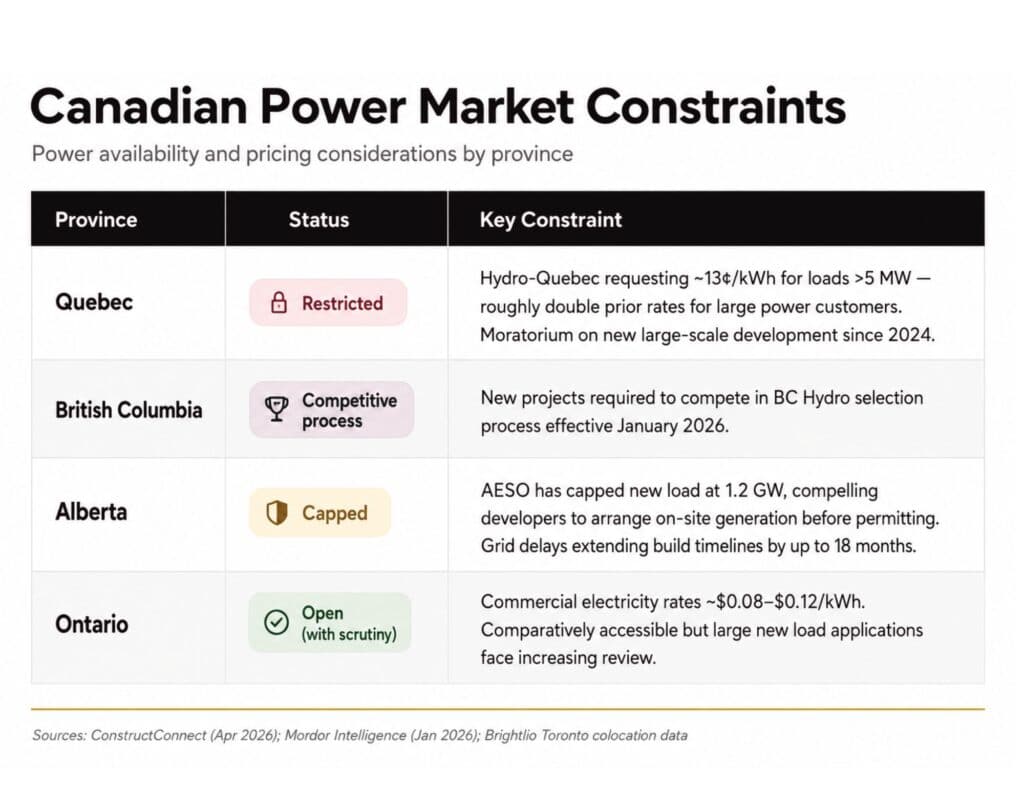
Power terms in a colocation agreement, or a power procurement strategy in a build scenario, are not details to resolve at execution. They are cost variables that can change the outcome of the whole decision.
Ontario’s relative accessibility to power is one reason Toronto has retained its position as Canada’s primary colocation market, but that advantage is not unlimited.

Ownership costs for data centres encompass capital expenses and operating expenditures, where the latter frequently exceeds the initial capital outlay over a full facility lifecycle.
Transitioning to cloud services may reduce these financial burdens through a consumption-based pricing structure, which also reduces server and storage redundancies.
Maintaining an on-premises data centre permits tailored customization and enhanced management oversight. Expanding such facilities usually necessitates substantial allocations of budget towards personnel and equipment.
Canada’s data centre colocation market is projected to reach USD $4.22 billion in 2026, having grown at a compound annual rate of 16.1% from 2021 to 2025. Growth is expected to continue at approximately 12% annually through 2030, reaching an estimated USD $6.64 billion. Significant hyperscale leasing activity in Toronto and Montreal is driving demand for adjacent wholesale colocation capacity, with availability in prime markets tightening.
For many organizations, colocation offers a practical middle path: retaining hardware ownership and operational control while outsourcing the facility, power, and cooling infrastructure to a specialist provider.
The comparison below summarizes how build, colocation, cloud, and hybrid models differ by use case, cost profile, and risk.
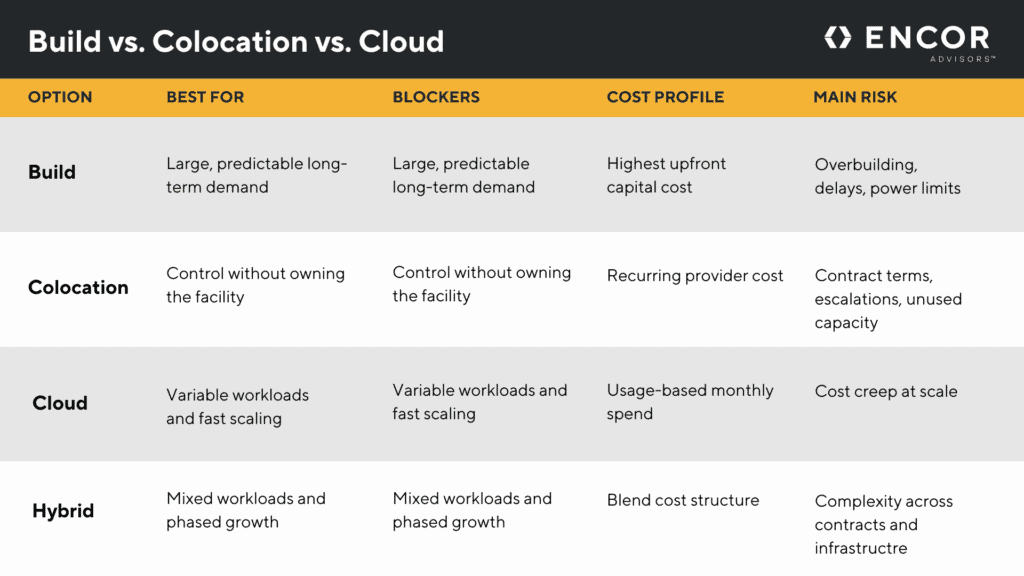
Cloud services provide the benefit of reduced upfront deployment expenses, yet over time these costs may accumulate and could exceed the initial cost of in-house solutions at large scale.
Typically, cloud solutions transform significant capital expenditure into operational spending, permitting companies to expend funds corresponding to their real-time use instead of committing to an extensive preliminary outlay.
For most organizations, the build-versus-outsource decision ultimately turns on three variables: the scale and predictability of future compute requirements, the organization’s ability to manage the operational complexity of running its own infrastructure, and whether the facilities available in the market can support the required workloads at a cost that makes sense over the full contract term.
By using modular designs, data centres gain the ability to scale up or down with flexibility, ensuring optimal expenditure.
This approach not only reduces construction costs and ongoing operational expenses but also facilitates access to scalable data centre space as requirements evolve.
Modular setups permit organizations to adjust capacity and components on an as-needed basis, enabling scalable and effective resource management.
Modular facilities carry a 20 to 30% higher upfront cost per megawatt compared to traditional builds, but allow phased capital deployment and avoid overcommitting to a specification that may need to change.
In an environment where AI workload requirements are evolving faster than standard facility build cycles, modular design also helps organizations avoid locking in a cost structure that no longer fits.
Hear from ENCOR’s Chief Growth Officer Jeff Howell, as he explains the largest expense and most common mistake made with companies renting server space.
By using modular designs, data centres gain the ability to scale up or down with flexibility, ensuring optimal expenditure. This approach not only reduces construction costs and ongoing operational expenses but also facilitates access to scalable data center space as requirements evolve.
Modular setups permit organizations to adjust capacity and components on an as-needed basis, enabling scalable and effective resource management.
Companies can future-proof their infrastructure, ensuring that their data centre can support future growth without requiring costly overhauls.
Managing labour costs efficiently can help lower the total operating costs of data centres.

Implementing automation and refining labour management strategies has proven effective in mitigating increasing operational costs within these facilities.
Using virtualization technology in data centres can lead to considerable savings on capital expenditures and operational costs by optimizing server utilization.
This is achieved by merging various workloads onto a smaller number of servers, reducing the expenses associated with hardware procurement and ongoing operations.
By consolidating multiple servers into fewer units via virtualization, data centres are able to cut down overall expenses substantially, including cost reductions related to energy consumption and maintenance.
By adopting modular data centre configurations, companies can realize considerable cost savings, investing in precisely the resources required at any given moment.
This approach minimizes upfront capital outlays by permitting gradual expansion and distributing expenses over time.
The energy efficiency of a data centre is heavily influenced by the performance of its cooling systems.
Enhancing cooling system performance is one of the most effective levers for reducing operational costs and carbon emissions.

By increasing energy efficiency in data centres, there is both a reduction in operational costs and a decrease in environmental footprint.
Organizations with active ESG commitments should factor PUE performance and renewable energy sourcing into any facility build or selection decision from the outset.
Practical examples shed light on the genuine expenses involved in constructing and maintaining data centres.
Costs vary significantly based on scale, purpose, AI readiness, redundancy level, and geographic location.
Small-scale server rooms or private IT environments may require a more modest capital outlay than enterprise data centres, but costs rise quickly once power, cooling, redundancy, security, and connectivity are factored in.
A basic on-premise server setup for a small business typically starts at $3,000 to $5,000 per server in hardware alone, before UPS systems, dedicated cooling, fire suppression, physical security, and network redundancy are added, each of which can multiply the initial figure.
Integration within existing office premises is possible for smaller deployments, but the gap between a functional server room and one that delivers enterprise-grade reliability is large and expensive to close.
For most small and mid-sized Canadian organizations, colocation provides access to Tier III-certified infrastructure, redundant power, and professional cooling at a fraction of the cost of replicating those conditions in-house.
Data centers tailored for enterprises typically necessitate substantial capital investment, with expenses frequently exceeding the million-dollar mark.
Big data center facilities face significantly higher annual operational costs, which can span from $10 million up to $25 million.
The financial outlay can vary widely based on operational dimensions, bespoke technological requirements, and whether the facility is designed to support AI workloads.
Building a data centre can cost very different amounts from one market to another. Land pricing, labour availability, grid capacity, permitting timelines, utility infrastructure, and access to fibre all influence the final budget.
In Canada, organizations should use sources like Altus Group’s Canadian Cost Guide and Statistics Canada’s Building Construction Price Index to understand regional construction cost conditions. However, those benchmarks should only be treated as a starting point.
Data centre projects require additional review because power, cooling, redundancy, security, and network requirements can materially change the final cost.
Understanding the full cost of building a data centre versus outsourcing to colocation or cloud requires looking beyond headline construction costs.
Site acquisition, power infrastructure, cooling systems, security, compliance, networking, staffing, and ongoing maintenance all contribute to total cost of ownership, and they compound materially over a multi-year commitment.
In 2026, AI workloads, power grid constraints, and cooling requirements are adding material complexity to every step of this decision.
The Canada Energy Regulator has identified new data centre demand as a factor in future electricity demand growth in Canada, which affects both site selection and the economics of long-term facility commitments.
Employing strategies aimed at reducing costs, including virtualization, modular designs, and energy efficiency improvements, can lead to considerable fiscal reductions.
Businesses must thoroughly evaluate these aspects when deciding upon the most suitable approach for their operational requirements and budget constraints.
If your organization is reviewing a colocation contract, planning new data centre capacity, or comparing build-versus-outsource options, ENCOR can help assess the real estate, infrastructure, and contract implications before you commit.
Request a complimentary data centre contract review to identify cost exposure, unused capacity, flexibility gaps, and negotiation opportunities before your next renewal or expansion.