



The hybrid work conversation has been dominated by theory for five years now. HR webinars, workplace consultants, and think pieces have all told you what hybrid is supposed to look like.
But when it comes time to renew your office lease, or sign a new one, theory stops mattering and the numbers take over.
The decisions you make in the next 12 to 24 months will lock in your real estate costs for the next five to ten years. Get the hybrid math wrong, and it can cost you hundreds of thousands of dollars.
Here’s what that reality check actually looks like.
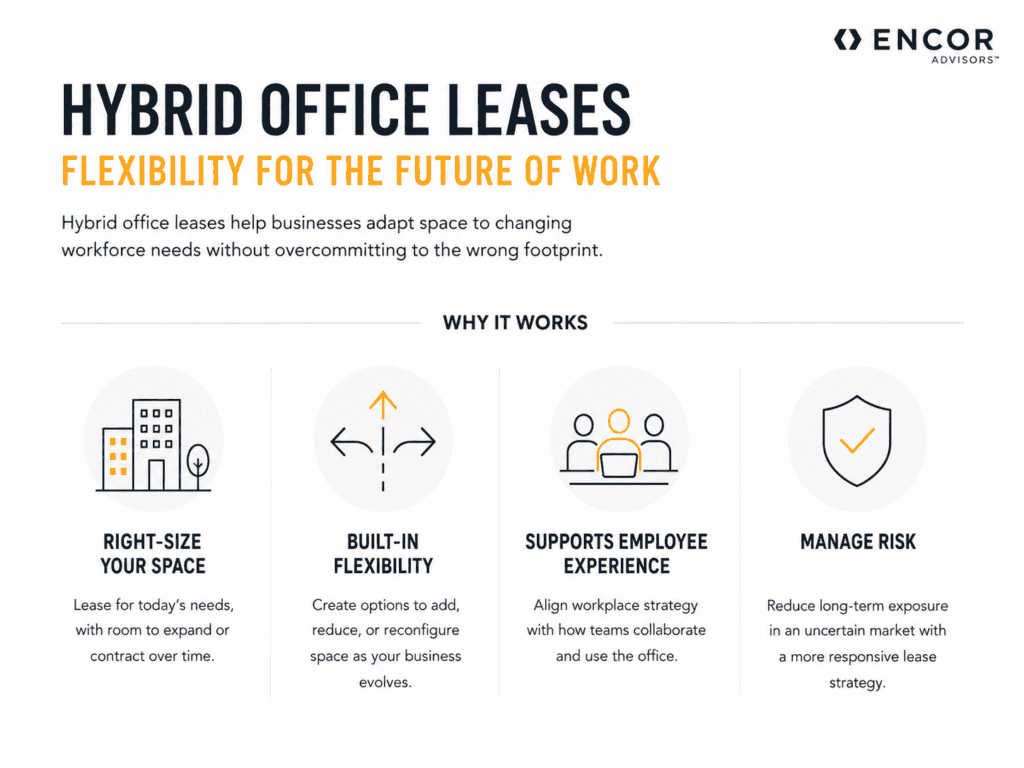
The most common mistake we see when clients renegotiate under the hybrid banner is treating it as a simple headcount reduction. The logic usually goes something like: we used to have 200 people in five days a week, now they’re here three days, so we need 60% of the space.
That math doesn’t hold up, and it gets expensive fast.
When people do come into a hybrid office, they come for a reason: collaboration, client meetings, onboarding, the hallway conversation that never happens over Zoom. That means peak occupancy days, usually Tuesday through Thursday, can still approach the old five-day averages. You’ve condensed your usage. You haven’t reduced it.
What’s changed is what the space needs to do. Private offices for heads-down work matter less. Conference rooms, collaboration zones, and quality shared amenity space matter more. The ratio has flipped.
This is a space configuration problem, not just a square footage problem. Most tenants sign their next lease without ever working through that distinction.
Post-pandemic office utilization data tells a more nuanced story than the headlines suggest.
Badge-swipe data from major North American markets shows most hybrid offices running at 40 to 60 percent of pre-pandemic occupancy on a given day, with peak days hitting 70 to 80 percent and Mondays and Fridays dropping below 30 percent. That unevenness is the defining feature of a hybrid office lease today.
In practical terms: you don’t just need less space, you need space that performs on peak days without feeling wasteful the rest of the week.
The organizations handling this well have moved away from assigned seating toward activity-based zones: focus rooms for deep work, open collaboration areas, formal meeting rooms, and social or amenity space. The right mix varies by industry and culture, but the principle holds across every deal we work on: design for the peaks, price for the averages.
A lease can also act like a forecast. It assumes a version of your future: how many people you’ll have, how you’ll use space, what you’ll need from your landlord. The hybrid shift has made several lease provisions far more consequential than they were five years ago.
If your current lease doesn’t include a contraction right, getting one into your next deal should be a priority. A contraction right lets you give back a defined portion of your space, typically one floor or 10 to 15 percent of your footprint, at a set point in the term, usually around the halfway mark.
In a hybrid environment, forecasting your space needs five years out is genuinely difficult. Will you grow? Contract? Reconfigure entirely? A well-negotiated contraction right is your insurance policy against getting that forecast wrong.
Your sublease provisions define what you can and can’t do with space you’re not using. Many standard commercial leases hand landlords significant control here: approval rights, recapture provisions, profit-sharing clauses.
In a market where plenty of tenants are over-spaced, sublease rights have become a frontline negotiating issue, not a boilerplate afterthought. Push for broad sublease rights with reasonable landlord consent standards, and push back hard on recapture language.
Longer lease terms typically buy you more leverage on rent. But in a hybrid world, a long term also locks you into a footprint and configuration that may not fit your needs by year six or seven.
The right balance depends on your growth outlook, but we’re advising more clients toward shorter initial terms (five to seven years) with renewal options, rather than chasing the lowest possible rent with a ten-year commitment. The flexibility is worth the premium.
If hybrid means reconfiguring your space, the tenant improvement (TI) allowance, the landlord’s contribution toward your buildout, matters more than it used to.
Converting a traditional perimeter-office layout into an activity-based model isn’t cheap. Budget $60 to $120 per square foot for a meaningful reconfiguration in most major Canadian markets.
A strong TI allowance can fund that transition. A weak one leaves you stuck either living in a space that doesn’t fit or writing a large cheque you didn’t plan for.
Here’s an uncomfortable truth: most companies start too late.
The typical corporate lease negotiation cycle kicks off 12 to 18 months before expiry. But the work that actually shapes your negotiating position, the comparative market analysis, the test fits, the landlord outreach, needs to start 24 to 36 months out.
Why? Real estate moves slowly, and your leverage is tied directly to optionality. The moment your landlord senses you have no viable alternative, your negotiating position collapses. Building real alternatives, even ones you never intend to use, takes time.
Hybrid work makes this timing problem worse. You need to do the internal space planning before you can even tell a landlord what kind of space you need. That planning takes time. So does test-fitting alternative buildings. So does getting executive alignment on the right footprint.
If you’re 18 months from expiry and haven’t started, you’re already behind. At 24 months out, you still have a workable window, but only if you move now.
Keeping too much space just in case. Hybrid hasn’t driven the deep contraction a lot of people predicted, but holding 20 to 30 percent more space than you actually use is expensive insurance. Negotiating flexibility into your lease is almost always cheaper than paying rent on empty square footage.
Letting the landlord define the hybrid conversation. Landlords love the idea that hybrid means you need amenity-rich, premium space, and sometimes they’re right. But the upsell from standard Class B space to “premier flex-enabled Class A” often prices in amenities you’ll never fully use. Evaluate the offering against your actual peak usage, not the marketing brochure.
Signing a standard lease in a non-standard market. Vacancy rates in many Canadian markets remain well above pre-pandemic levels. Tenants have real leverage right now. Landlords who are filling space are doing it with meaningful concessions: free rent, strong TI allowances, flexible terms. If your renewal isn’t being tested against the open market, you’re likely leaving money on the table.
Underestimating reconfiguration costs. Plenty of companies plan to convert to an activity-based workplace as part of their next lease, then get a construction quote and quietly drop the idea. Plan for these costs early. A well-structured TI negotiation puts the landlord’s capital to work on the reconfiguration you actually need.
Before you sit down with a landlord, or even with your internal facilities team, you need answers to five questions.
What is your actual current utilization? Not headcount, not assigned desks: real occupancy across the week. Badge data or sensor data if you have it. If you don’t, get it before you make any space decisions.
What does your workforce plan look like for the next three to five years? Growth trajectory changes the whole equation. A company adding 50 people in 18 months has a very different space problem than one that’s flat.
What does your hybrid policy actually require from the office? Not what the policy says on paper, but what people actually do when they show up. Map the real use cases, then design for them.
What are your real alternatives? Market survey, test fits, site visits. Know the competitive landscape before you signal anything to your current landlord.
Who is representing your interests? A tenant rep advisor who works exclusively for tenants, with no landlord business, gives you unfiltered advice and full market access. That’s a different relationship than a transactional broker, and it’s the right choice for a lease this complex.
Hybrid work hasn’t made office space obsolete. It’s made the wrong office space obsolete.
The companies handling this well aren’t the ones who slashed their footprint by 40 percent and called it done. They’re the ones who did the internal work to understand what their office actually needs to accomplish, matched that to the right configuration, and negotiated a lease built to flex with them.
Your lease is one of the biggest financial commitments your organization makes. In a market with this much complexity, and this much tenant leverage, the quality of advice you bring to that negotiation matters more than it ever has.
If you want to talk through what hybrid work actually means for your specific situation, that’s what we do.
ENCOR Advisors is a tenant-only commercial real estate advisory firm serving tenants across Canada. That means the advice you get from us is always in your corner.
Ready to start your lease strategy conversation? Contact ENCOR Advisors.
Your questions answered
A hybrid office lease is a commercial lease negotiated around a hybrid work model, where employees split time between the office and remote work.
Rather than sizing space to total headcount, a hybrid office lease accounts for peak-day occupancy, flexible lease terms, and space configured for collaboration rather than assigned desks.
Size your space to peak concurrent occupancy, the highest number of employees in the office on your busiest day, not your total headcount.
Most hybrid offices see 40 to 60 percent of pre-pandemic occupancy on an average day, but peak days (typically Tuesday to Thursday) can hit 70 to 80 percent.
Cutting square footage to match average attendance usually leaves you short-staffed on the days that matter most.
A contraction right lets a tenant give back a defined portion of leased space, typically one floor or 10 to 15 percent of the total footprint, at a set point in the lease term, usually around the halfway mark.
It’s one of the most valuable protections a tenant can negotiate into a hybrid office lease, since it hedges against overestimating long-term space needs.
Many tenant advisors now recommend five- to seven-year terms with renewal options, rather than locking into a ten-year term for the lowest possible rent.
Hybrid work patterns are still evolving, and a shorter term with renewal rights preserves flexibility to adjust footprint and configuration as your workforce plan changes.
Budget $60 to $120 per square foot for a meaningful reconfiguration from a traditional layout to an activity-based hybrid model in most major Canadian markets.
A strong TI allowance from the landlord can fund most or all of that buildout, so it’s worth negotiating hard on this line rather than accepting a standard allowance built for a conventional layout.
Start 24 to 36 months before your lease expires, even though the typical negotiation cycle only kicks off 12 to 18 months out.
Hybrid work adds a planning step, internal space and utilization analysis. That has to happen before you can even define what you need from a landlord. The earlier work matters more than it used to.
Yes. In a market where many tenants are carrying more space than they use, broad sublease rights with reasonable landlord consent standards are a frontline negotiating point, not boilerplate.
Watch for landlord recapture provisions, which let the landlord reclaim space you try to sublease, and push back on those during negotiation.





| Cookie | Duration | Description |
|---|---|---|
| cookielawinfo-checkbox-analytics | 11 months | This cookie is set by GDPR Cookie Consent plugin. The cookie is used to store the user consent for the cookies in the category "Analytics". |
| cookielawinfo-checkbox-functional | 11 months | The cookie is set by GDPR cookie consent to record the user consent for the cookies in the category "Functional". |
| cookielawinfo-checkbox-necessary | 11 months | This cookie is set by GDPR Cookie Consent plugin. The cookies is used to store the user consent for the cookies in the category "Necessary". |
| cookielawinfo-checkbox-others | 11 months | This cookie is set by GDPR Cookie Consent plugin. The cookie is used to store the user consent for the cookies in the category "Other. |
| cookielawinfo-checkbox-performance | 11 months | This cookie is set by GDPR Cookie Consent plugin. The cookie is used to store the user consent for the cookies in the category "Performance". |
| viewed_cookie_policy | 11 months | The cookie is set by the GDPR Cookie Consent plugin and is used to store whether or not user has consented to the use of cookies. It does not store any personal data. |