



Most financial services office lease negotiations in Toronto are still anchored to 2023 conditions.
The 2026 market is different.
Understanding the current landscape of financial services office lease Toronto is crucial for firms looking to reduce overhead while maximizing operational efficiency.
Toronto office availability sits at 15.5%, down 270 basis points year over year, with six consecutive quarters of positive net absorption in the downtown core. Competition for high-quality Class AAA contiguous blocks is increasing, and concessions in the top segment are starting to compress.
Class B and older Class A inventory may still offer leverage, but the broad discounts that shaped 2023 negotiations are no longer applying evenly across the market.
Inside many Bay Street firms, peak office attendance on the busiest day of the week still fills only part of the footprint under lease. Mondays and Fridays often remain lighter.
Landlords sending renewal proposals understand this shift. They also know which segment your firm sits in. Many CFO responses are still calibrated to a softer market than the one now forming at the top of the stack.
Five assumptions are doing the most damage.
The headline availability number tells only part of the story. For financial services CFOs, what matters is the bifurcation underneath it.
The Toronto office market is no longer uniformly soft. The top end of the market is tightening first, especially in high-quality downtown buildings where demand is being shaped by return-to-office mandates, limited new supply, and stronger competition for contiguous space.
As that segment tightens, the concessions that were easier to secure in 2023 are becoming less automatic. Large TI allowances, extended free rent, and generous contraction rights may still be available in some cases, but they are no longer applying evenly across the market.
Older Class A and Class B inventory still tell a different story. Tenants may still find meaningful leverage in non-trophy buildings, but the gap between top-tier and older space is becoming more important. Negotiation strategy now depends less on the market average and more on the specific building, submarket, quality of space, and landlord motivation.
This is the market financial services firms are actually negotiating in. For tenants in non-trophy segments, leverage still exists. For firms pursuing high-quality space in the Financial Core, timing and preparation now matter more. The mistake is assuming every landlord is still negotiating from the same position they were two years ago.
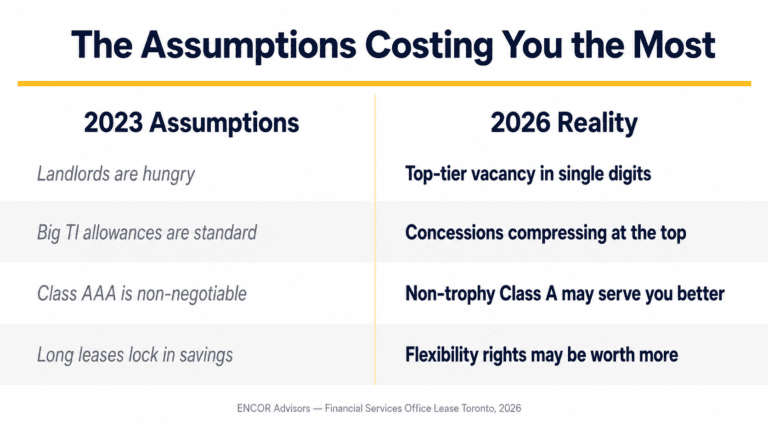
This assumption was always worth testing. In today’s market, it is worth testing urgently.
The top end of Toronto’s office market is tightening first. Downtown Class A availability fell to 11.1% in Q1 2026, down 600 basis points year-over-year, reflecting stronger demand for high-quality space and a continued flight to quality.
That does not mean every financial services firm needs to compete for the same trophy floorplate. Client meetings happen on screens. Investor calls happen on screens. Diligence rooms are often virtual. For many firms, the actual number of physical client touchpoints is lower than the office strategy assumes.
The question is not whether space quality matters. It does. The better question is whether every team, function, and client interaction requires premium Financial District space.
A well-chosen Class A building just outside the tightest core may still support the firm’s brand, client experience, and employee expectations while creating meaningful cost flexibility. On a 25,000 square foot footprint, even an $8 to $12 per square foot rent differential represents $200,000 to $300,000 per year before factoring in operating costs, inducements, or tenant improvement allowances.
The right answer now depends on where you sit in the quality stack.
For trophy and Class AAA space in Toronto, where premium availability is tightening and new supply remains limited, locking in current rates on a longer term may be the disciplined move. This segment is better positioned for upward rent pressure than the broader market.
For Class A non-trophy and Class B inventory, the answer may be different. Vacancy remains more elevated outside the highest-quality assets, and some landlords are still willing to trade economics for certainty. A long-term lock-in at today’s net rents can remove flexibility that may matter more than rate certainty.
The other consideration is footprint. Long leases lock in not just rate, but square footage. If hybrid work compresses your team further, or if a business line is restructured, you may be paying for excess space until expiry.
For many financial services tenants outside the trophy tier, the stronger play is to negotiate shorter terms, contraction rights, or termination options at year three or five. The premium for that flexibility should be compared against the much larger cost of carrying surplus space.
For example, if flexibility costs $0.50 to $0.75 per square foot annually, that is $15,000 to $22,500 per year on a 30,000 square foot lease. Compare that to being locked into 10,000 square feet of surplus space for several extra years, especially in a market where occupancy and construction costs remain elevated.
This was the rule from 1985 to 2019. It is not the rule now.
The benchmark in financial services pre-pandemic was roughly 200 to 250 square feet per employee in private-heavy environments, or 150 to 180 in open-plan setups.
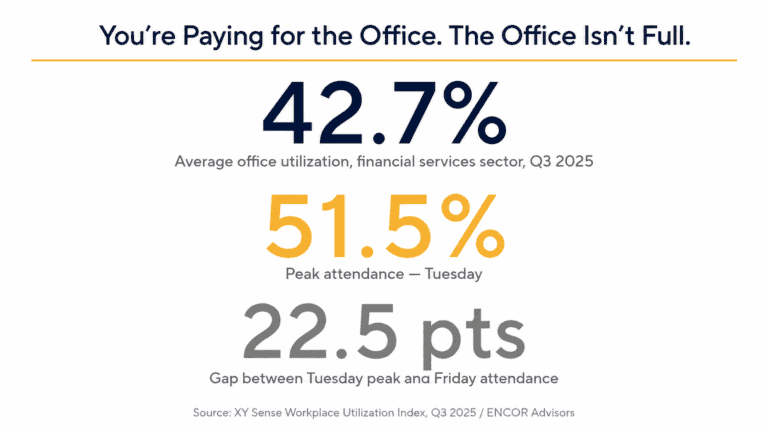
Post-pandemic, workplace utilization data shows offices are still far from full on a typical week. In Q3 2025, average utilization was 42.7%, with Tuesday peaking at 51.5% and Friday remaining 22.5 points below Tuesday.
If you are paying for 30,000 square feet to house a team whose peak attendance fills 16,000, you are paying twice for half the space.
The right footprint is now driven by peak attendance day, not headcount. For most financial services firms with a three-day-in-office policy, that math points to a 25 to 35% reduction in optimal square footage.
The catch: you cannot capture that reduction inside a long-dated lease without either subleasing surplus space or negotiating contraction rights at renewal. Both require lead time and leverage. Both depend on knowing your actual occupancy numbers, not your assumed ones.
Two years ago, sublease space was often the cheapest option in the market. That window has narrowed.
Sublease availability has been shrinking as tenants either reoccupy space, transact on built-out options, or let temporary listings expire. The best opportunities are no longer sitting in the market the way they were in 2023.
Selective options still exist, especially outside the trophy tier. Some listings may still offer meaningful savings compared with direct space, but the discount depends on the building, remaining term, landlord consent, existing buildout, and how motivated the sublessor is.
The trade-off is term. A sublease only runs for the remaining term of the original lease, so it can work well for a bridge, project space, market test, or restructuring period. It is less suitable if you need long-term certainty for an anchor headquarters.
The signalling concern is manageable. If the space feels temporary, poorly branded, or clearly second-hand, employees will notice. If it is a high-quality built-out floor, lightly refreshed, properly branded, and presented as a smart real estate decision, the discount does not need to be visible to anyone but the CFO.
The landlord will negotiate when you have leverage. You have leverage when you have a credible alternative.
That alternative is not theoretical. It is a competing building with real economics, a workable relocation timeline, and enough internal alignment to show your incumbent landlord you can actually move. That requires lead time. For larger office renewals, the leverage window opens well before expiry. Wait too long, and your options narrow. By the time relocation is no longer realistic, the landlord knows your negotiating power has weakened.
In current conditions, well-prepared tenants outside the trophy tier can still negotiate meaningful improvements, including:
None of these outcomes happen by accident. They require a prepared, competitive process.
The CFOs who get the best outcomes follow a sequence that starts 18 to 24 months before expiry. They commission an independent workplace utilization study and benchmark current rent against today’s market, by asset class, not against the market they last leased in.
They identify three to five credible alternative buildings and have a tenant rep advisor approach each one cold, without revealing tenant identity, to establish real economics. They then return to their incumbent landlord with a fully-documented competitive position.
The landlord, knowing the alternatives are real, negotiates from a posture of retention rather than dominance. The result can be a stronger commercial outcome: sharper economics, better contraction rights, stronger escalation caps, improved tenant improvement allowances, and more flexibility over the term.
What this approach is not: a quick conversation with the landlord’s leasing rep three months before expiry.
Your questions answered
In almost all financial services office lease negotiations in Canada, the landlord pays the tenant advisor’s fee through a market-standard commission structure already baked into the deal.
The tenant pays nothing direct.
If you negotiate without representation, the landlord keeps the portion that would have gone to your advisor.
You do not save money. The landlord does.
For tenancies above 15,000 square feet, start 18 to 24 months before expiry. Below 15,000 square feet, 12 to 18 months is acceptable but you will have less leverage.
The reason is leverage timing.
To negotiate seriously, you need a credible alternative on the table. Identifying, touring, and obtaining LOIs on alternative buildings takes 4 to 8 months. You then need 6 to 10 months to negotiate either a renewal or a relocation.
Working backwards, the 18-month mark is when serious work starts.
A renewal is a fresh negotiation on essentially new terms (often a new term length, new rent schedule, new TI allowance, sometimes new space).
An extension is typically a short add-on to an existing lease at predetermined terms, often the same or near-same rent.
In current market conditions for non-trophy space, an extension is almost always worse for the tenant. A renewal lets you reset to current market economics, which still favour you in Class A non-trophy and Class B inventory. An extension preserves the landlord’s pre-existing economics, which usually do not.
For trophy Class AAA tenants, the calculation is closer. With rents under upward pressure, an extension at near-current terms may now be competitive with a fresh renewal.
It is not too late.
A landlord-initiated proposal is the opening of negotiation, not the close. The numbers in that proposal almost always represent the landlord’s best case, not yours.
You can still bring a tenant advisor in, run a competitive process, and use the data to negotiate the proposal down. The earlier you do this after receiving the proposal, the better, but the leverage window does not fully close until you have signed.
Yes for Class B and older Class A inventory across Toronto, Vancouver, and Calgary downtowns. No longer for trophy Class AAA space, where vacancy moved into single digits in 2025 and supply is tightening.
Some asset segments (small-floorplate boutique buildings, newer LEED-Platinum towers, and select trophy buildings with full amenity programmes) now command premium economics. Other segments (older Class A, Class B/C downtown) remain meaningfully soft.
The market is bifurcated, and tenants need to know which segment they are actually competing in. A renewal strategy calibrated to the wrong segment leaves money on the table either way.
It applies across financial services subsectors with some adjustment. Asset managers, insurance carriers, brokerages, wealth managers, and fintech firms all operate in the same downtown office markets and face the same landlords.
The size of the footprint, the importance of client-visit signalling, and the regulatory build-out requirements differ. The underlying market dynamics and negotiation principles hold.
The one major distinction is firms with regulatory operational resilience requirements (some banks, certain insurance carriers, registered dealer-brokers) that have specific physical security, redundancy, and continuity infrastructure baked into their location selection. Those constraints narrow the option set but do not eliminate leverage.
Then your strategy is renewal-focused, not relocation-focused. You should still benchmark, still run a partial competitive process, and still negotiate, but the goal shifts from “find cheaper space” to “lock in current economics with better terms and flexibility.”
If you are substantially below market, you have unusual leverage on terms, free rent, TI, and contraction rights even if the rent itself does not move much.
Do not let “we have a good rent” become a reason to skip negotiating everything else.





| Cookie | Duration | Description |
|---|---|---|
| cookielawinfo-checkbox-analytics | 11 months | This cookie is set by GDPR Cookie Consent plugin. The cookie is used to store the user consent for the cookies in the category "Analytics". |
| cookielawinfo-checkbox-functional | 11 months | The cookie is set by GDPR cookie consent to record the user consent for the cookies in the category "Functional". |
| cookielawinfo-checkbox-necessary | 11 months | This cookie is set by GDPR Cookie Consent plugin. The cookies is used to store the user consent for the cookies in the category "Necessary". |
| cookielawinfo-checkbox-others | 11 months | This cookie is set by GDPR Cookie Consent plugin. The cookie is used to store the user consent for the cookies in the category "Other. |
| cookielawinfo-checkbox-performance | 11 months | This cookie is set by GDPR Cookie Consent plugin. The cookie is used to store the user consent for the cookies in the category "Performance". |
| viewed_cookie_policy | 11 months | The cookie is set by the GDPR Cookie Consent plugin and is used to store whether or not user has consented to the use of cookies. It does not store any personal data. |