



You plan to renew your lease. The lease renewal timeline Canada companies follow turns on a different question: when does that plan have to become a written notice?
Why has the old lease renewal timeline Canadian tenants relied on stopped working?
The old playbook of starting a lease renewal six to nine months before its expiry assumed a market with an abundance of space to spare still existed. That assumption no longer applies to many tenants, as the opportunity that defined Toronto’s office market begins to shift.
New supply of space will not rescue a late starter. Toronto’s eight office projects under construction total roughly 2.2 million square feet, with availability above 22%. Cost pressure is also building, with non-residential building construction costs up 3.5% year over year across the 15-city composite in Q2 2026.
A lease renewal timeline Canadian tenants built for a commodious market leaves them negotiating against a calendar instead of a landlord.
At nine months out, the landlord’s renewal proposal arrives. It reads as a modest rent adjustment, a short free-rent period, perhaps a small improvement allowance. The company’s lawyer reviews the lease and finds the renewal option, along with a notice requirement.
In Ontario, notice is typically due six to twelve months before the end of the term, and some leases require it as early as 18 to 24 months. At month nine, this company is either inside that window or has just left it. Missing the deadline usually means the option is lost, and while relief from forfeiture is occasionally available, courts usually require strict compliance with the notice terms.
The CFO then asks whether relocating is an option. Practically, it isn’t. A single-site transaction management process, covering market analysis, shortlisting, tours, LOI negotiation and lease review, generally runs three to six months. Design, permitting and construction come after that. For work in the City’s Large and Complex Building Stream, review targets are 20 business days for large buildings and 30 for complex ones, and there is no timeframe at all for incomplete applications. A relocation that cannot finish before expiry is not a credible alternative, and the landlord can read a calendar as well as the tenant can.
So the firm signs the renewal with a few small concessions, or takes a short extension at near-current terms. To see what is at stake, take a worked example. If the gap between the landlord’s proposal and the achievable market rent is $3 per square foot per year, a 30,000 square foot tenant on a five-year term gives up $90,000 a year and $450,000 across the term. Those inputs are assumptions, not a market finding.
The larger losses never appear in the rent line: contraction rights, termination options, and a real say in the improvement allowance. Starting late and accepting the first proposal rank among the costliest office lease renewal mistakes tenants make.
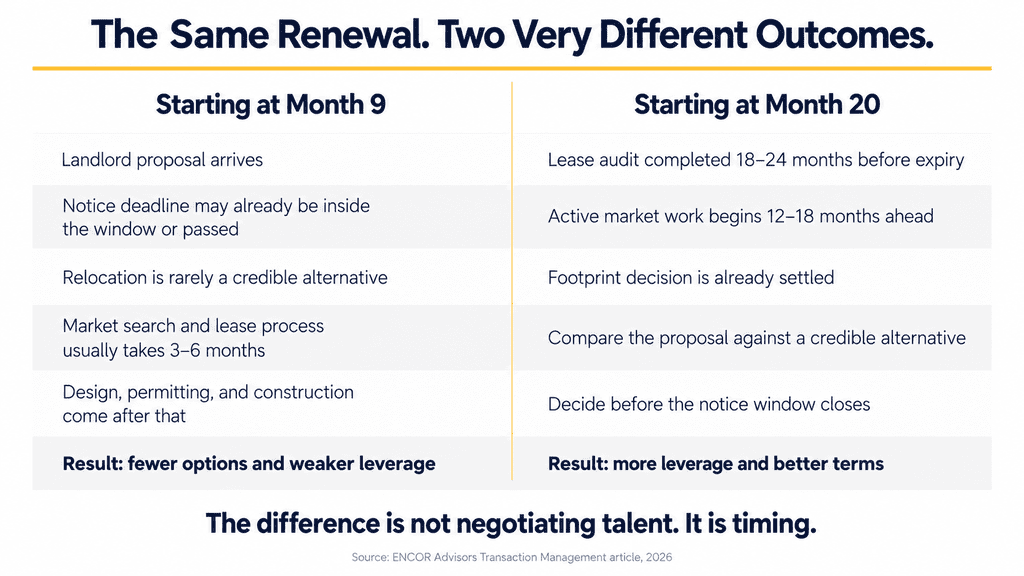
Now take the same firm at month 20. A lease renewal timeline Canada companies can defend starts earlier. A full lease review belongs 18 to 24 months before expiry, with active market work starting 12 to 18 months ahead for office tenants. Set against a notice window of six to twelve months, that leaves months of working room before the earliest likely deadline.
What changes in this version is the sequence, not the negotiating skill. By the time the proposal arrives, the firm has made its footprint decision, holds a real alternative, and knows its deadlines. The proposal becomes one input instead of the starting position. Coordinating renewal and market search as one process is what transaction management delivers for corporate tenants across acquisition, renewal, relocation and disposition.

The difference between the two paths is not negotiating talent. One firm still had options on the day the proposal arrived, and the other did not. Options in a lease cycle expire on a schedule: notice windows close, shortlists thin out, and construction timelines cannot be compressed.
Not every tenant needs 20 months. A small single-site tenant on a short lease with flexible space needs may require less. But the arithmetic of the notice date applies to everyone, and it is the first thing to check. Ontario has no statutory default notice period for commercial leases, so the lease wording is the only rule that applies. Open your lease this week, find the notice date, and count backward. That date is the outer edge of your own timeline.
A tenant with a lease expiring in 2027 is already inside the window where active market work should be under way. Industrial tenants face the same arithmetic, and the review-first sequence for a GTA industrial lease is the same.
Not sure where you stand on your lease expiry? Contact an ENCOR Advisor today.