



The GTA industrial market saw availability rise to 5.3% in Q3 2026, an increase of 60 basis points year over year, while net absorption turned negative after four consecutive positive quarters. With new industrial developments entering the market and much of the newly delivered space still uncommitted, tenants are seeing more options than in previous quarters.
The space with the most room to negotiate is often new speculative products or older inventory, while modern, well-specified buildings continue to attract demand. Occupiers planning for 2027 need to understand which part of the market they are actually shopping in.
The GTA industrial market posted four consecutive quarters of positive net absorption from Q2 2025 through Q2 2026, followed by a return to negative absorption in Q3. The same market update attributes the shift to new supply entering the market, longer corporate approval cycles and greater cost sensitivity among occupiers.
Longer approval cycles matter here. Slower tenant decisions add uncertainty to lease-up timing, and occupiers with a clear internal process can move quickly when the right building appears. National conditions point in the same direction. The Canadian industrial market update for Q3 2026 puts national availability at 6.2% and links the result to trade uncertainty.
For occupiers, the practical point is that availability is rising, but it has not yet produced a broad drop in pricing or a flood of suitable options.
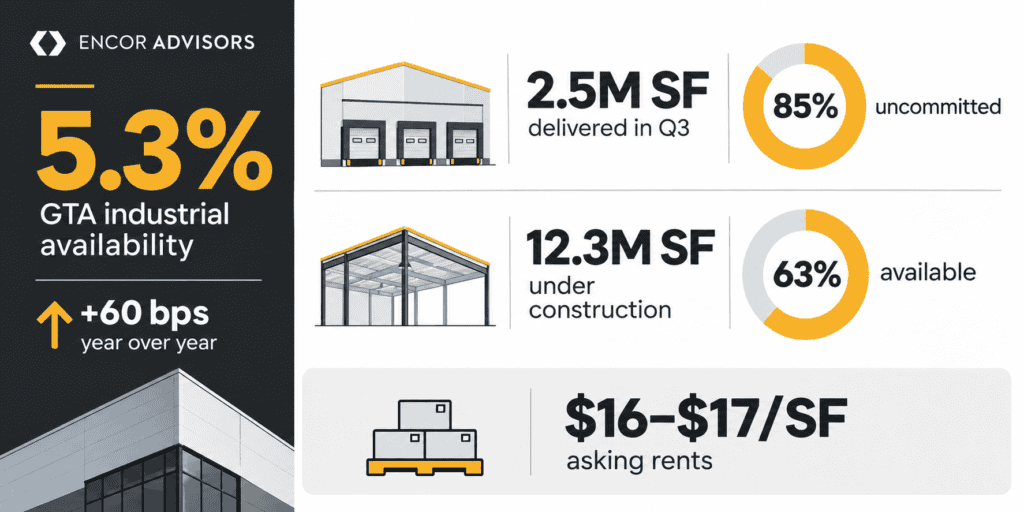
New supply is the main reason the market has more choice. Nine industrial projects delivered nearly 2.5 million square feet in Q3, and 85% of that space was uncommitted at quarter-end. A further 43 projects totalling 12.3 million square feet were under construction, and 63% of that pipeline remained available.
Uncommitted space gives an occupier a different kind of opportunity. A building without a committed tenant has not yet locked in its rent roll, which can make the owner more open to discussion on timing, build-out and lease structure. Occupiers should not assume that this translates automatically into specific concessions, since the terms available on any building will depend on its leasing status, location and specifications.
It is expected that the active pipeline will place upward pressure on availability into early 2027. This suggests uncommitted space will remain a large share of the market for some time. Occupiers that wait for better conditions should weigh that possibility against the risk that the most suitable buildings will be leased first.
This is where market headlines and operating reality diverge. The Toronto market update notes that demand remained concentrated in high-specification Class A facilities with modern clear heights, ample power capacity and advanced logistics technology. It also describes a flight to quality, in which that demand absorbed part of the new supply and limited the rise in overall availability. Older buildings are not seeing the same pull.
For an occupier, the important question is whether the available building can support the operation. Several specifications determine that answer:
Some logistics occupiers are also holding larger inventories as a hedge against trade disruption, which supports demand for strategically located distribution space.
Older space can look like a bargain on a rent comparison, yet a building that requires electrical work, layout changes or additional labour to run efficiently may cost more to occupy than its headline rate suggests.
Estimated asking rents remain at approximately $16 to $17 per square foot, broadly unchanged since early 2025. That suggests the market is not in a broad rent decline.
A single market range, however, cannot tell an occupier what a specific building will cost to run. A facility at the lower end of the range may still be more expensive to operate if it needs power upgrades, reconfigured loading, longer transport routes or additional labour. Occupiers should compare buildings on total occupancy cost, including operating costs, the capital required to make the space functional, and the operational efficiency the building enables. Asking rent is a starting point for that comparison, not the conclusion.
As the GTA industrial market heads into 2027, tenants have more options, but building suitability remains essential. Availability is elevated, and the pipeline is expected to add further upward pressure. Headline rents are holding. Trade policy remains unsettled, and corporate occupiers are maintaining resilience strategies and inventory models for near-term volatility rather than retreating, according to the Toronto market update.
Financing conditions have also changed. The Bank of Canada raised its target for the overnight rate by 25 basis points to 2.50% on October 28, 2026, according to its policy rate announcement. That decision affects the cost of capital for owners and developers, and it may influence how occupiers weigh leasing against ownership. This article does not attribute the Q3 changes in GTA leasing to the rate decision.
Increased choice will benefit tenants who know exactly what they need. A company with defined clear height, power, loading, expansion and location requirements can evaluate new space quickly and negotiate from clarity. A structured transaction management process can help tenants carry those requirements through site evaluation, lease negotiations, and execution.